

Choosing the Right Auger Attachments for Excavators
Picking an auger attachment for your excavator isn't as straightforward as it might seem. Choosing the right auger attachment for your excavator comes down to understanding your machine's hydraulic specs, the ground conditions you'll face, and the diameter of holes you need to drill.
Read on to learn how to select an auger drive based on hydraulic flow and pressure, pick the correct mounting option for your excavator, and match auger bits to your drilling conditions.
Understanding Auger Attachments for Excavators
An auger attachment transforms your excavator into a precision drilling machine. The system consists of a hydraulic motor connected to a planetary gearbox, which amplifies torque output while reducing rotational speed.
The hydraulic motor converts your excavator's oil flow and pressure into rotational force. This motor connects to a planetary gearbox that multiplies torque through multiple gear sets. More gear sets mean higher torque output, but slower rotation speeds.
How Hydraulic Auger Drives Work
Smaller excavators need fewer gear sets to maintain adequate RPM for efficient drilling. On the other hand, larger machines can handle additional gear reduction because they provide higher hydraulic flow rates.
At the bottom of the gearbox sits the output shaft. The shaft size varies based on the drive unit's power output, ranging from 2" hex on compact units to 4.33" square on heavy excavators.
Hydraulic Specifications
Your excavator's hydraulic specs determine which auger drive will work correctly. Two numbers matter most: flow rate (measured in GPM) and pressure (measured in PSI).
Finding Your Machine's Auxiliary Circuit Specs
Look for the auxiliary hydraulic circuit specifications in your operator's manual. This circuit powers attachments and runs separately from your excavator's main hydraulic system. You'll find auxiliary ports on your machine's stick with quick-connect fittings.
Check how your auxiliary circuit operates. A single-acting circuit only flows in one direction, controlled by a button or pedal. Meanwhile, a double-acting circuit lets you reverse flow direction using a joystick roller or two-way pedal.
Excavator Mounting Systems Explained
Excavators lack a universal mounting system like skid steers use. Each machine has different pin dimensions and spacing, so you'll need a mount built specifically for your excavator's specifications.
Measuring Your Excavator's Pin Dimensions
Five measurements define your excavator's pin configuration. The stick width (A and B dimensions) establishes the overall frame size. Pin diameters (C and D) vary by machine weight class. Lastly, pin-to-pin center distance (E) determines the vertical spacing between attachment points.
Grab these measurements from a bucket or attachment that currently fits your machine. Many excavator models appear in manufacturer pin size charts, but verifying with an existing attachment eliminates guesswork.
Single Pin Mounts for Compact Drives
Smaller auger drives can mount through the excavator's main pin alone. This setup costs less and is installed quickly but gives you limited control over the drive unit's position because the auger hangs vertically from the single pin point.
Single pin mounts work best for lighter drilling tasks where precise positioning matters less.
Double Pin and Cradle Configurations
A double pin mount attaches at both the stick and bucket pin points. This rigid connection provides better control and stability during drilling operations. You can position the auger more precisely and apply downward force more effectively.
The cradle lets you tuck the drive close to the excavator when moving between drilling locations. You can also flip the mount to hold the drive horizontally for angled or horizontal drilling work.
Selecting Output Shafts and Auger Diameters
Output shaft size directly affects which auger bits you can use and how much torque reaches the cutting head. The shaft must match your drive unit's power output and the auger diameter you plan to run.
Standard Output Shaft Sizes by Machine Type
Mini skid steers and compact excavators typically use 2" hex or 2-9/16" round shafts. These smaller shafts handle auger diameters from 4" up to 36" depending on the drive unit's torque capacity.
Mid-size excavators in the 7-15 ton range often feature 2.5" hex outputs. This size accommodates augers from 6" to 48" diameter. Larger excavators up to 22 tons run 3" square (75mm) shafts for 6" to 60" augers.
Heavy excavators over 22 tons require 4.33" square (110mm) output shafts. These machines drill holes from 12" to 72" diameter using industrial-grade auger bits built to withstand extreme torque loads.
Auger Diameter Guidelines
Ground conditions also limit how large an auger you can run on any given drive unit. Soft soil lets you push toward the upper end of the diameter range. Rocky or compacted ground requires dropping down to smaller diameters even with the same drive unit.
A 6000-40 drive rated for 24" augers in normal soil might only handle 18" bits in rocky conditions. Stay within manufacturer recommendations to prevent damage to your drive unit and auger bits.
Auger Bit Types and Ground Conditions
The auger bit you choose makes the difference between smooth drilling and constant frustration. Different ground conditions demand specific bit designs, tooth configurations, and flight patterns.
Earth Auger Bits for Standard Soil
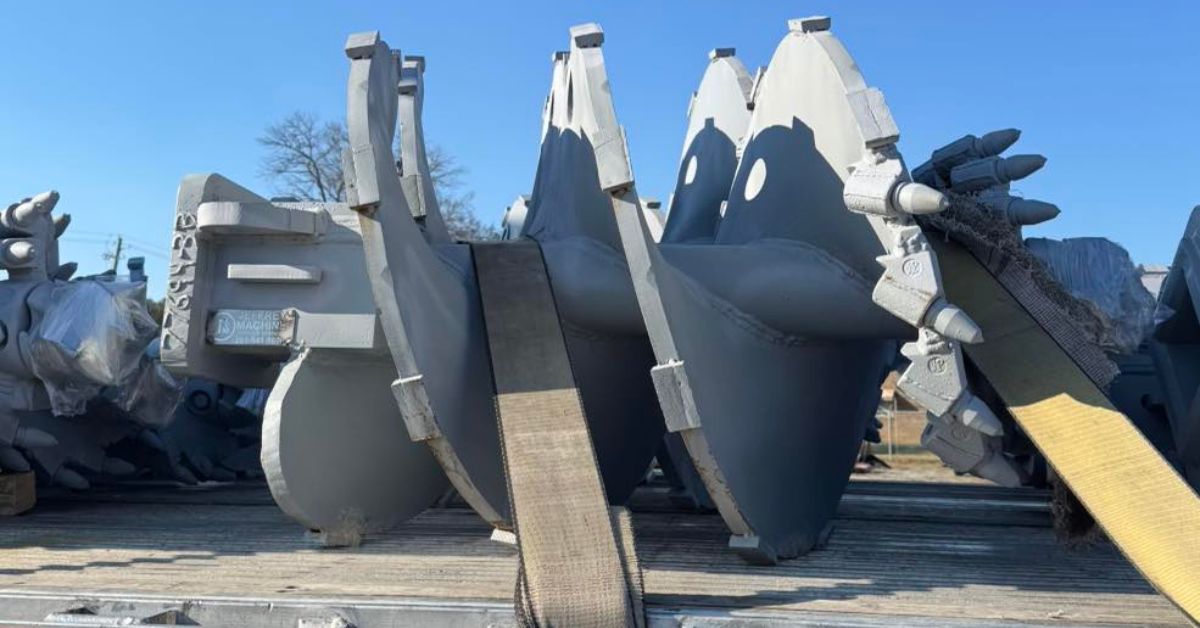
Earth auger bits feature a standard single-flight design with flat cutting teeth. The flight spacing and pitch move loose material up and out of the hole efficiently. These bits work best in clay, silt, sandy soil, and other soft- to medium-density ground.
The hub or collar connects to your drive unit's output shaft, and the tube diameter and wall thickness increase with larger auger sizes to handle higher torque loads. Flight thickness also scales up on bigger bits to resist bending under load.
Rock Auger Bits for Hard Ground
Rock bits use tungsten carbide cutting teeth arranged in an aggressive pattern. The teeth can chip through fractured rock, frozen ground, and heavily compacted soil.
Some rock augers feature a stepped flight design. This includes thicker flighting near the cutting head that handles the initial impact and stress. The flight thickness reduces higher up the shaft where loads decrease, saving weight while maintaining the needed strength.
Hybrid and Multipurpose Options
Multipurpose bits combine features from both earth and rock designs. They might use carbide teeth on a single-flight pattern, or incorporate a moderately aggressive boring head with standard flight spacing.
These hybrid bits handle a wider range of conditions than specialized designs. You'll sacrifice some performance in extreme conditions, but gain flexibility for varied job sites. A hybrid bit works well if you encounter different soil types on the same project.
Final Considerations
Choosing the right auger attachment for your excavator requires matching multiple factors simultaneously. Your machine's weight class, hydraulic specifications, and pin dimensions narrow down drive unit options. The ground conditions and hole sizes you typically encounter determine which auger bits you need.
Take the time to spec your attachment correctly, and you'll recover that investment through faster job completion and reduced labor costs.
For durable auger tooling parts that can withstand any rigorous project, trust Jeffrey Machine. We offer a comprehensive inventory of high-quality drive units, auger bits, and replacement parts engineered for maximum performance and longevity. Our expert team can assist you in selecting the precise components to match your excavator's specifications and typical ground conditions. Contact Jeffrey Machine today!